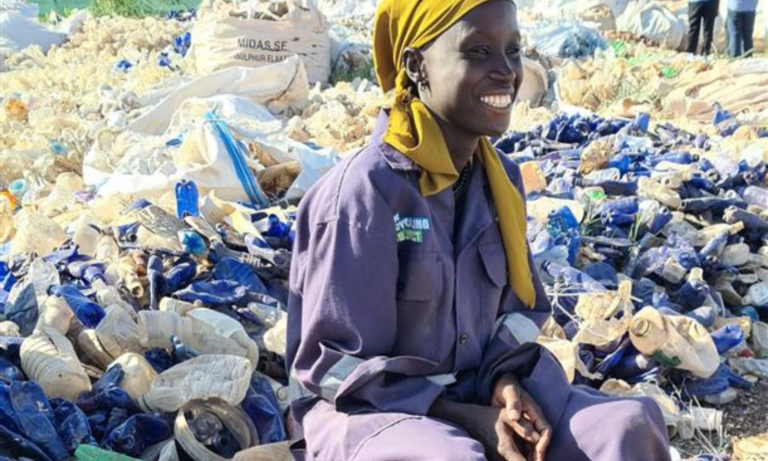
In the heart of the swirling sands and harsh arid heat of Turkana desert in northwestern Kenya you will find more than 285,000 displaced people sheltering in Kakuma Refugee Camp. An area set aside in 1992 to shelter the ‘Lost Boys of Sudan’ that today has grown to look more like a sprawling city. As conditions become increasingly crowded the infrastructure needed to safely sustain those trying to rebuild their lives here becomes more and more complex. A challenge which requires a long-term coordinated approach and must include the often-overlooked element of solid waste management.
Cue the SWEEP (Sustainable Waste Employment and Environmental Progress) partnership. A global collaboration between WASTE, Last Mile Climate, the Danish Refugee Council, and other key stakeholders, to collectively address solid waste management (SWM) challenges in displacement settings. Acknowledging too the critical role SWM plays in emergency response settings, particularly within refugee camps, where daily waste generation is significant and growing.
Scoping study
As a first focus area of the partnership, WASTE, with over 40 years of SWM experience, was commissioned to carry out a scoping study of the state of SWM in Kakuma Refugee Camp and the adjoining Kalobeyei settlement. This involved utilising our Integrated Sustainable Waste Management (ISWM) model which allows for an analysis of the current SWM system.
SWEEP is collaborating with governments, businesses, NGOs, and community groups to make sustainable waste management and green employment a reality for displaced communities. Join us in this transformative journey to create an inclusive and formalised plastic recycling ecosystem, integrating marginalised waste pickers into the formal economy. To find out more reach out to our Senior Solid and Plastic Waste Management Expert, Sophie van den Berg on: [email protected].