Home / Waste fractions / Organic waste / Fact sheet Anaerobic Digestion

Updated: Tuesday 03 May 2005

Fact sheet Anaerobic Digestion

Anaerobic digestion is the breakdown of organic material by micro-organisms in the absence of oxygen. Although this takes place naturally within a landfill, the term normally describes an artificially accelerated operation in closed vessels, resulting in a relatively stable solid residue.
Biogas is generated during anaerobic digestion (AD) - mostly methane and carbon dioxide - this gas can be used as a chemical feedstock or as a fuel.
Anaerobic digestion can treat many biodegradable wastes, including wastes that are unsuitable for composting, such as meat and cooked food.

History of AD

Anecdotal evidence indicates that biogas was used for heating bath water in Assyria 3,000 years ago. The first digestion plant was said to have been built at a leper colony in Bombay, India in 1859. AD reached England in 1895, when biogas was recovered from a sewage treatment facility to fuel street lamps in Exeter, Devon.
In Germany in 1951 half the biogas from sewage sludge was being converted for use as fuel for cars. AD has also been used to treat agricultural waste for several years and it now treats segregated municipal solid waste. Putrescibles and paper in household waste are ideally suited to anaerobic digestion, as are certain types of garden waste.

The process

The process begins with separation of household waste into biodegradable and non-biodegradable waste. The biodegradable material is shredded, slurried and then screened and pasteurised to start the process of killing harmful pathogens. It is then pumped into the digester where bacteria break down the material and form biogas, leaving a digestate. Figure 1 shows a typical schematic for an AD plant.
There are three main process stages in anaerobic digestion, as follows (as also in Figure 2):

Hydrolysis

Insoluble organic polymers such as carbohydrates, cellulose, proteins and fats are broken down and liquefied by enzymes produced by hydrolytic bacteria.
Carbohydrates, proteins and lipids are hydrolysed to sugars which then decompose further to form carbon dioxide, hydrogen, ammonia and organic acids. Proteins decompose to form ammonia, carboxylic acids and carbon dioxide. During this phase gas concentrations may rise to levels of 80 per cent carbon dioxide and 20 per cent hydrogen.

Acidogenesis

Organic acids formed in the hydrolysis and fermentation stage are converted by acetogenic micro-organisms to acetic acid. At the end of this stage carbon dioxide and hydrogen concentrations begin to decrease.

Methanogenesis

Methane (60%) and carbon dioxide (40%) are produced from the organic acids and their derivatives produced in the acidogenic phase. The methane is a useful fuel source and methanogenic bacteria play a further role in maintaining wider breakdown processes.

Efficient mixing of the contents of the digester improves the contact between the material and the resident bacteria. Mixing of the waste slurry in the digester is important in maintaining a high rate of anaerobic biodegradation and a high production level of gas. The mixing process disperses the incoming waste within the digesting sludge, improving contact with the micro-organisms.

Monitoring the acidity within the digester is necessary to provide optimum conditions for the balanced growth of bacteria. Monitoring takes place in the reactor using probes. The concentration of volatile fatty acids is an important parameter for monitoring as this can be the first indicator that digestion is not progressing normally.

Digesters

Digesters can be categorised by dry or wet systems – below 15 per cent dry solids is termed wet. Also digesters can operate within two temperature ranges, either at 350C (mesophilic) or 550C (thermophilic) Some are loaded in batches while others have continuous feed. On completion of the process digesters are emptied leaving 10-15 per cent behind as a seed culture for the next batch.
Various AD processes have been developed, operating at different temperatures, moisture levels and speeds. The purity of material fed into the AD process determines the quality of the end product. Some plants are designed to remove as many other materials as possible (for example, ferrous metals) before digestion. Others are designed to optimise gas collection for energy production and a soil conditioner may not be their main objective. Others might optimise the horticultural product, regarding energy of secondary importance. All of the processes share a common approach where shredded materials and water are held in a reactor for 6-25 days at a constant temperature between 35-550 C.

Wet continuous digestion

Waste is slurried with a large proportion of water to give a feedstock of 10 per cent dry solids. Glass and stones must be removed to prevent them accumulating in the bottom of the reactor. This method can be used for co-digestion of biodegradable waste with sewage sludge.

Multi-stage wet digestion

There are a range of multi-stage wet digestion processes which take municipal solid waste and add to recycled liquor. The mixture is fermented by micro-organisms to release volatile fatty acids. These are then converted to gas in a specialised high-rate industrial digester.

Dry batch digestion

Waste is fed into the reactor with digested material from another reactor and then the digester is sealed. Leachate is collected from the bottom and is re-circulated to distribute nutrients and micro organisms and maintain even moisture levels.

Leach-bed process

Similar to the dry batch method, but once the third stage of methanogenesis is reached the reactor is connected to a fresh batch of waste in a second reactor.

Dry continuous digestion

Waste is fed continuously into a digestion reactor with 20-40 per cent dry matter.
The process of anaerobic digestion in a digester takes about 35 days, which compares favourably with a landfill site which may remain active for 35 years producing methane and leachates which can harm the environment.

Digestate use

Digestate is the residual fibrous material left at the end of processing. End-use ranges from landfill cover, landspread for agriculture or the production of a high quality soil conditioner after an additional maturation process. The quality of the original input biowaste determines the quality of the digestate at the end of the process. The efficiency of the source-separation systems is important as the contamination of the biowaste with potentially toxic chemicals and too many non-biodegradable inclusions will be apparent in the final product. The presence of heavy metals severely limits its eventual use.
The digestate produced by most operational plants is destined for use as a soil conditioner and most have a useful level of nutrients resulting in less demand for inorganic fertilisers. There is also evidence that using digestate on land has the benefit of suppressing normal pathogen and parasite levels.
Depending on the quality of the original feedstock, digester residue can be used for landfill cover or further matured into a compost product.

Figure 1
Schematic diagram for a typical Dry Continuous Single Stage Anaerobic Digestion system - the DRANCO Process
Source: International Energy Agency technology review (1997)

Biogas

During the process of anaerobic digestion the organic wastes produce biogas. This is composed largely of methane (60%) and carbon dioxide (40%). Methane is a greenhouse gas thirty times more damaging than the equivalent amount of carbon dioxide. The quality of the biogas produced from AD affects its final usefulness. The main concern in this context is the presence of hydrogen sulphide which occurs as a metabolic bi-product of sulphur-reducing bacteria in the digester. Hydrogen sulphide can rapidly corrode the gas-handling and electricity generating equipment in the plant.
If one tonne of putrescible food waste consists of 77 per cent water and 23 per cent solids, the digester will convert approximately 75 per cent of the solids to biogas.
The maximum possible yield of biogas in is 400m3 , but in practice is nearer to 100m3 . This has an energy value of around 21-28 MJ/m3 . Between 20 - 50 per cent of the energy produced will be used to run the plant.
Biogas may be used directly or as a replacement fuel for kilns, boilers and furnaces located close to the AD site. If the gas is used in power generation gas clean-up is required to remove corrosive trace gases, moisture and vapours.

Process liquor

There has been a focus on the digestate and biogas production from AD but the process liquor is often overlooked. There are however environmental considerations and costs to be considered with the generation of contaminated water. Some process liquor is used to re-wet incoming biowaste as it contains useful bacterial populations. This method can produce a faster reaction then the original start-up. If all the liquor was recycled in this way however, the concentration of contaminants would become too high. Excess liquor can be disposed of in three ways: discharge, landfill or landspreading. Discharge is the simplest but it may be expensive to achieve environmental standards required by regulators.
Limits on certain chemical components are likely to be in place. Discharge into the sewerage system is more likely to be permitted than to a water course. AD process liquors can be very polluting and treatments may include aeration de-nitrification and reverse osmosis techniques.
A major area of concern is the heavy metal content particularly when considering application to land, and also nitrogen and phosphorous content.
Haulage charges for transporting contaminated water to disposal may be a third of the total transport and disposal fee.

Energy use

Whereas composting is an energy-consuming process, requiring 50-75 kilowatt-hours per tonne (kWh/t) MSW input, AD is a net energy-producing process (75-150 kWh/t MSW). The amount of energy required to run a digester is directly related to the moisture content of the feedstock. High-moisture systems use more heat but require less electricity to circulate the fluid digestate. Anaerobic digestion requires an additional 15kWh/ton of energy in comparison to aerobic composting plants.

Odour

Several aerobic plants have been closed or put under constant review due to odour complaints. In anaerobic systems most volatile components are broken down by bacteria in the digester. A study has shown that whereas 588g/t of volatile organics were produced in aerobic composting, only 3g/t were produced in an anaerobic system.

Figure 2 Flowchart indicating the main stages in Anaerobic Digestion
Source: Evans G, Biowaste and Biological waste treatment 2001

Economics of AD

The capital investment required for a modern AD plant are less than those of an energy from waste plant but similar to those of a materials reclamation facility (MRF). Experience in Europe suggests that a plant which can handle up to 15-20,000 tpa is the smallest scale which will be financially viable. High costs are imposed by the superior technical requirements to provide adequate gas seals to prevent air ingress, safe gas handling and internal environmental controls and monitoring techniques, such as the detection of very low levels of concentrations of hydrogen (an intermediate product).
When the digestion process is complete the digester is emptied and 10 – 15 per cent may be left behind as a starter for the next batch.

Benefits

Anaerobic digestion is a net producer of energy – a renewable energy source. It reduces leachate and landfill gas production, while
generating a valuable soil conditioner (and less need for artificial fertilisers).
Enclosed AD systems enable all of the gas produced to be used.
Problems
Anaerobic digestion is relatively expensive and requires a major capital investment. Waste water from the process may contain a high concentration of metals, nitrogen and organic materials.
Because of the complex association of different types of bacteria, digesters have a higher risk of breakdown and may be difficult to control. The variable nature of the waste may be a problem for AD plants. In summer households produce more organic kitchen wastes and grass clippings, while in autumn prunings and woody materials predominate.

Anaerobic capacity

Anaerobic capacity currently stands at less than five per cent of the total composting capacity in Europe, with about 1.2 million tonnes (Mt) of household and mixed waste being treated in biogas plants.
In Denmark 1.1 Mt biodegradable wastes are treated annually each year. Plants can treat between 15 - 100,000 tpa organic wastes.

Conclusion

The technology behind AD is able to process MSW biowaste but there are limitations to the process. AD systems are best designed for waste reduction or methane production. If the aim is methane production, the quality of the feedstock is not critical. However for most applications the aim is to achieve maximum breakdown and have a usable product at the end of the process.
The nature of the feedstock in this case is of great importance.
This, in conjunction with cost, is the most common argument against AD.
Cost is always an issue but where the economics are favourable the particular advantages of AD, especially the volumetric reduction achievable over other biological treatment methods, may make AD a desirable option.
Because of regulatory changes regarding biowaste management, companies are now exploring AD technology for future commercial advantage.

FileInformation sheet on Anaerobic Digestion

The above text can be downloaded here as pdf

WB89-InfoSheet(Anaerobic Digestion).pdf  (207 kB)


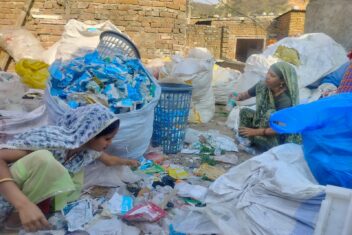
Compost filled in bags ready for sale